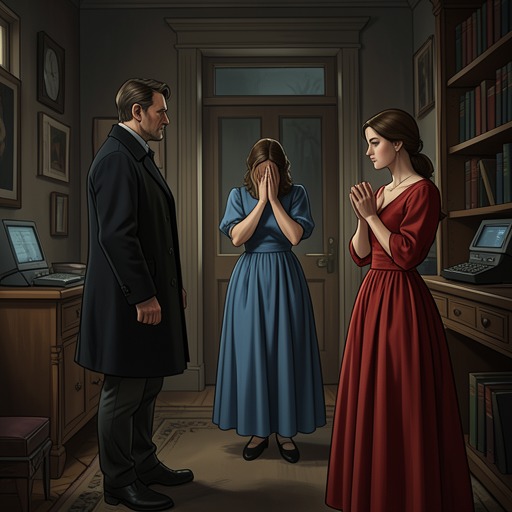
Boris Yvain—Geneviève
The King in YellowBoris Yvain—Geneviève is the love relationship at the center of a concealed emotional triangle involving Boris Yvain, Geneviève, and Alec. It begins within the warmth of artistic friendship and apparent domestic ease, but its unspoken tensions become destructive when Geneviève, delirious with fever, names Alec as the object of her hidden sorrow. The revelation overturns the lovers’ understood arrangement, and Geneviève’s subsequent death in Boris’s laboratory pool is followed immediately by Boris’s suicide.
Formation Within the Artistic Circle
Boris Yvain and Geneviève are presented through the world of sculpture, studios, salons, and intimate companionship. Boris is a sculptor whose unfinished group, the "Fates," surrounds the friends in his studio. His completed "Madonna," for which Geneviève had sat, was an exquisite marble and the sensation of the previous year’s Salon. The work makes their connection visible in public artistic terms: Geneviève is both his model and the figure through whom his reputation has advanced, while Boris’s dissatisfaction with the merely academic "Ariadne" shows that the "Madonna" represents a higher achievement shared between artistic devotion and romantic attachment.
The lovers’ relationship is not described through a formal declaration or a courtship scene. Instead, it is embedded in familiarity, aesthetic idealization, and the assumptions of those around them. Boris and Geneviève appear to belong together, and Alec recognizes that arrangement even while carrying his own unspoken love for Geneviève. The relationship therefore develops under a pressure that is social as well as emotional: the three friends inhabit a single circle, and the friendship that supports their artistic lives also keeps the rival attachment constantly present.
Geneviève Between Ideal and Volatility
Alec’s description of Geneviève divides her between two contrasting forms. Her face can possess Madonna-like purity, a stillness associated with sacred music and artistic serenity. Yet he prefers the shifting moods that the friends call her "April Manœuvres": grave and dignified in the morning, laughing and capricious at noon, and unpredictable by evening. This contrast matters to the relationship because Boris’s love is bound to a woman whom the surrounding artistic imagination repeatedly turns into an image, while her changing behavior resists remaining a single idealized figure.
Her conduct toward Alec changes noticeably at a luncheon scene. Dressed in silvery grey, she fails to give him her customary kiss from her fingertips and instead offers a hand that drops away almost immediately. She then tells Boris that he must ask Alec to stay for luncheon, although she had always asked Alec herself before that day. The small alteration in manners exposes a new strain within the household. When Geneviève returns without her bonnet, with an unusually deep colour and unusually bright eyes, she takes Alec’s arm, then Boris’s, and insists that Alec knows Boris is the person she likes best in the world, while still placing Alec immediately after him. Her attempt to arrange affection openly has the instability of a reconciliation performed before the conflict has been understood.
The Hidden Rivalry and Its Revelation
Alec’s love for Geneviève has never been acknowledged between them, yet it is known to Boris. After Geneviève tells Alec, with tears in her eyes, that Boris is the man she loves, Alec visits Boris and congratulates him. The interview is perfectly cordial, but neither man is deceived by its surface. Alec believes that the meeting comforts them both precisely because it permits the rivalry to be recognized without being spoken. He also believes that Boris and Geneviève never discussed the matter directly, although Boris understood what Alec felt.
This fragile arrangement collapses during Geneviève’s fever. After Boris has been experimenting with a lethal solution that turns living creatures into marble, Geneviève becomes violently ill. She sits upright with crimson cheeks and glittering eyes, babbles continuously, and resists Boris’s gentle restraint. Alec is summoned to help. At his first touch, she sighs and sinks back, but then opens her eyes, looks directly at Boris, and reveals her secret while fever tortures her. She speaks Alec’s name, and the confession converts a concealed emotional difficulty into an irreversible fact.
The scene changes the structure of all three lives at once. Alec experiences shame and sorrow because Geneviève’s delirious words expose the love he had never admitted. He cannot silence her and cannot face Boris. Boris, in turn, turns a bloodless face toward Alec and tries to release him from blame, saying that it is not Alec’s fault if Geneviève loves him. His inability to finish the thought leaves the attempted generosity suspended between compassion, devastation, and the knowledge that the previous balance among the friends cannot be restored.
Death, Suicide, and the Destruction of Evidence
The relationship’s final crisis occurs after Geneviève has been placed under the influence of drugs. Jack Scott later reports that he found Boris working on the "Fates" while Geneviève slept. As Boris continued sculpting, the third figure of the group—the figure looking straight ahead over the world—came to bear Boris’s face as it appeared in that period and remained to the end. The sculpture thus becomes a silent record of the lover’s transformed condition: the emotional catastrophe is incorporated into the unfinished work even before the deaths occur.
Near midnight, Boris and Jack hear a door open and a swift rush in the adjoining room. Boris reaches the room first, with Jack following, but they are too late. Geneviève lies at the bottom of the pool with her hands across her breast. Boris then shoots himself through the heart. The sequence gives the relationship no reconciliation, renewed union, or surviving promise. Geneviève’s death and Boris’s suicide form a single terminal movement in which the lovers’ bond is sealed not by public acknowledgment but by the destruction of both participants.
Jack’s response also shows how closely the love story is entangled with Boris’s scientific discovery. He drains the hellish fluid from the pool, washes the marble clean, empties the remaining solution into the waste pipe, destroys the jars and bottles, burns Boris’s papers, notebooks, and letters, and smashes the empty vessels. He then helps conceal the deaths from the public, arranges for the servants to be sent away, and accepts a certificate identifying Boris’s death as heart disease. The effort to erase the formula and conceal the circumstances also erases the material traces of the relationship’s final scene, leaving the account dependent on fearful testimony rather than public evidence.
Narrative and Thematic Significance
Boris Yvain—Geneviève is a tragic love plot shaped by concealment, artistic idealization, and the dangerous collision between private feeling and experimental power. Its central reversal is not simply that Geneviève loves Alec rather than Boris; Alec already knows that she has chosen Boris, and Boris already knows of Alec’s love. The decisive revelation is that the hidden attachment has survived beneath the apparent settlement and emerges in a condition—fever delirium—in which no participant can control its consequences.
The relationship also links creation with destruction. Geneviève’s image gives Boris his celebrated "Madonna," while the "Fates" absorbs his altered face after the relationship fractures. At the same time, the laboratory pool turns living bodies into marble, making the lovers’ deaths inseparable from the discovery that Boris has pursued. The artistic circle therefore cannot keep love, sculpture, and forbidden experiment in separate domains: each becomes the medium through which the others are expressed.
The ending subverts the expected resolution of a romantic triangle. Alec does not claim Geneviève, Boris does not recover from the revelation, and Geneviève’s fever does not produce a durable truth that can be lived with. Her disclosure instead becomes the immediate prelude to two deaths. What remains is an image of affection that had seemed perfectly cordial and socially manageable until the pressure of illness, jealousy, guilt, and scientific obsession made its concealed structure visible. Bodily life, artistic form, and emotional allegiance all harden into irrevocable loss.